Tuesday 14 of July of 2026
CTSh Step by Step: Calculation, Variables, and Economic Impact
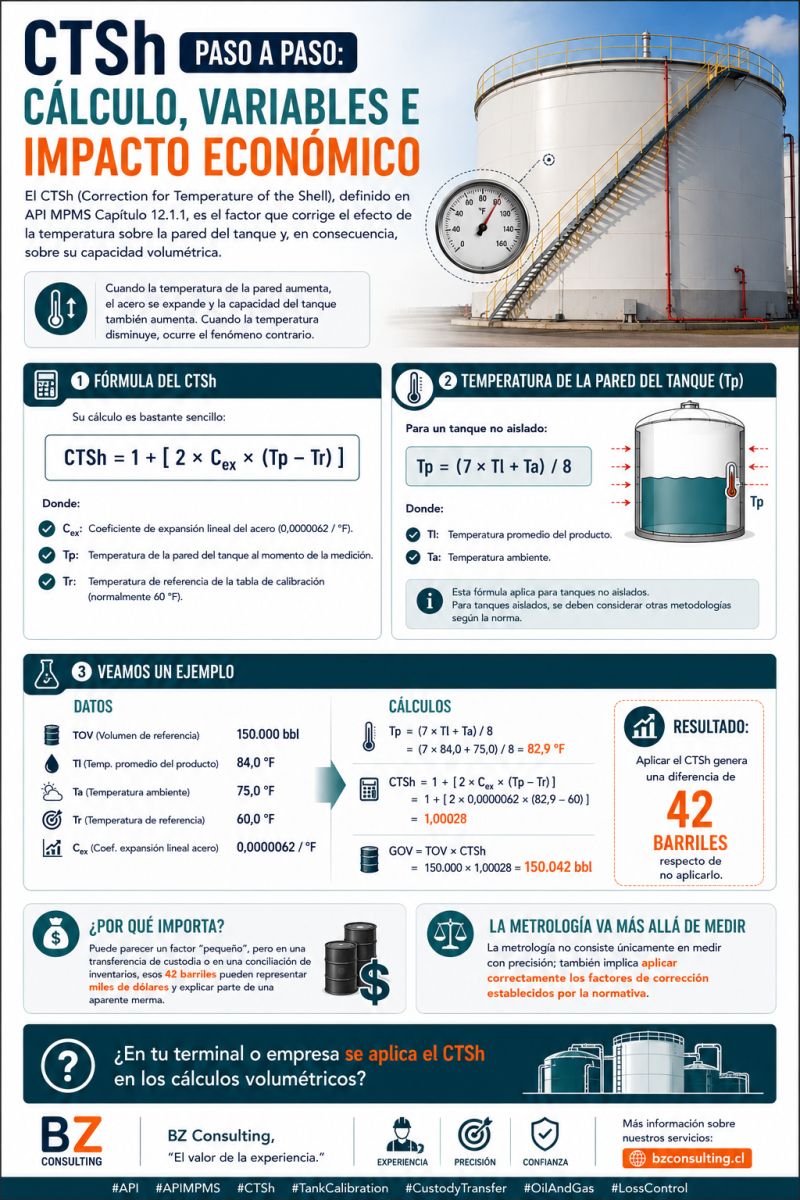
CTSh (Correction for Temperature of the Shell), as defined in API MPMS Chapter 12.1.1, is the factor that corrects for the effect of temperature on the tank shell and, consequently, on its volumetric capacity.
When the shell temperature increases, the steel expands and the tank capacity also increases. When the temperature decreases, the opposite occurs.
Its calculation is quite simple:
CTSh = 1 + [2 × Cex × (Tp − Tr)]
Where:
- Cex: Linear expansion coefficient of steel (0.0000062 /°F).
- Tp: Tank shell temperature at the time of measurement.
- Tr: Reference temperature of the calibration table (normally 60 °F).
For a non-insulated tank:
Tp = (7 × Tl + Ta) / 8
Where:
- Tl: Average product temperature.
- Ta: Ambient temperature.
Let Us Look at an Example
- TOV: 150,000 bbl
- Tl: 84.0 °F
- Ta: 75.0 °F
- Tr: 60.0 °F
- Cex: 0.0000062 /°F
Calculations:
Tp = 82.9 °FCTSh = 1.00028GOV = 150,000 × 1.00028 = 150,042 bbl
Result: applying CTSh produces a difference of 42 barrels compared with not applying it.
It may seem like a “small” factor, but in a custody transfer or inventory reconciliation, those 42 barrels can represent thousands of dollars and explain part of an apparent loss.
Metrology is not only about measuring accurately; it also involves correctly applying the correction factors established by the applicable standards.
Does your terminal or company apply CTSh in volumetric calculations?