Wednesday 18 of November of 2026
Weighted average temperature: simple average or volume-weighted?
In hydrocarbon measurement, correctly determining temperature is essential to obtaining reliable results in volume calculations.
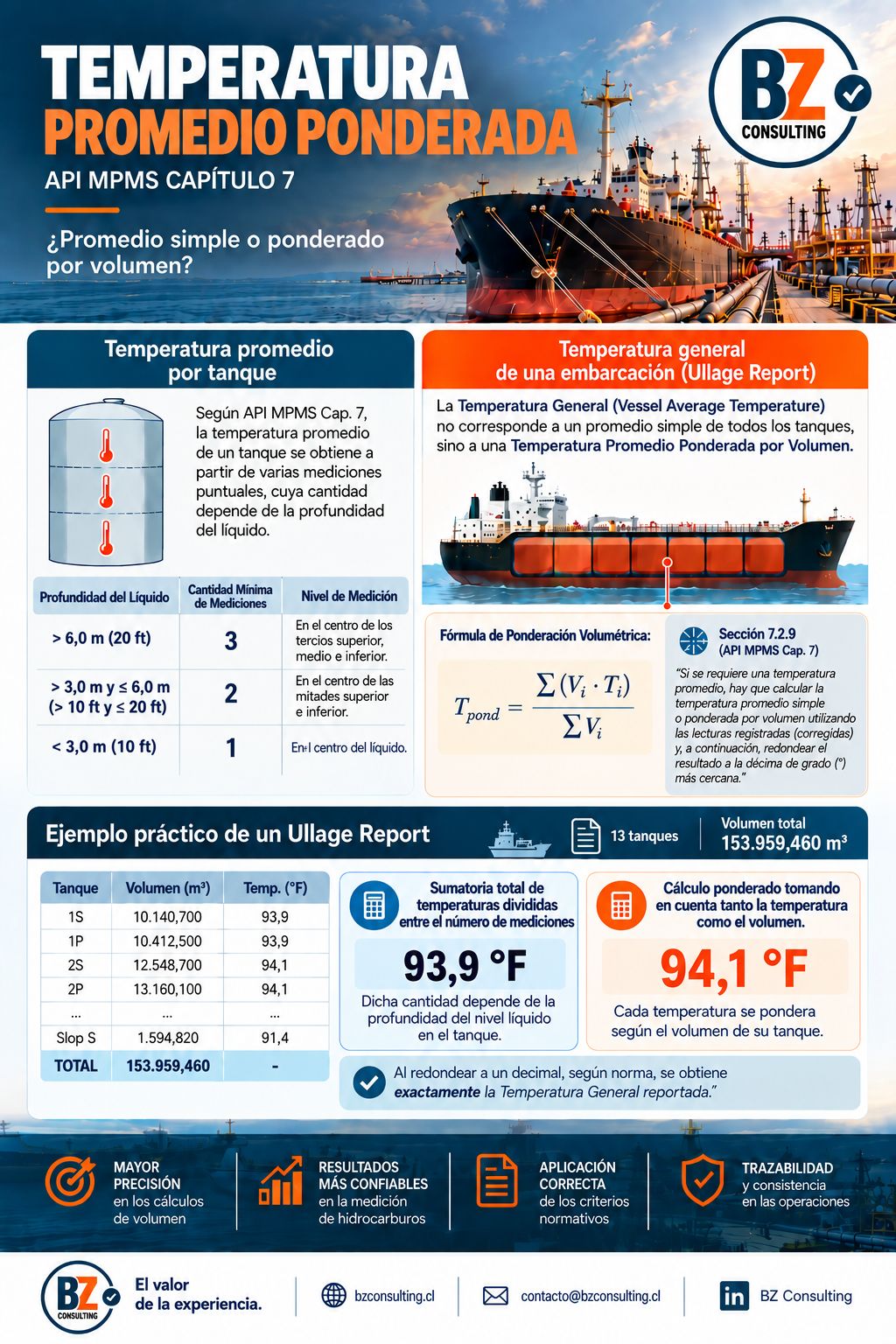
According to API MPMS Chapter 7, the average temperature of a tank can be determined through several spot measurements, the number of which depends on the liquid depth and the applicable conditions.
How many temperature measurements should be taken?
According to the criteria set out in the standard:
| Liquid depth | Measurements | Location |
|---|---|---|
| > 6.0 m (20 ft) | 3 | At the middle of the upper, middle and lower thirds |
| > 3.0 m and ≤ 6.0 m (> 10 ft and ≤ 20 ft) | 2 | At the middle of the upper and lower halves |
| ≤ 3.0 m (10 ft) | 1 | At the middle of the liquid |
However, there is an important difference to consider:
Important: The Vessel Average Temperature in an Ullage Report is not determined by a simple average of the temperatures of all tanks when volumetric weighting should be applied.
When tanks contain different volumes, a Volume-Weighted Average Temperature is used.
What happens in practice?
Consider an Ullage Report with 13 tanks and a total volume of 153,959.460 m³.
| Calculation method | Result |
|---|---|
| Simple Average | 93.9 °F |
| Volume-Weighted Average | 94.1 °F |
Results expressed to one decimal place, in accordance with the criteria of API MPMS Chapter 12.1.1 (Table 1).
Simple Average: add the recorded temperatures and divide the result by the number of measurements.
Volume-Weighted Average: takes into account both the temperature and the volume of each tank, giving each measurement a share proportional to its volume.
How is it calculated?
Volume-Weighted Average Temperature = Σ (Volume × Temperature) / Σ Volumes
Section 7.2.9 of API MPMS Chapter 7 establishes the calculation of the simple or volume-weighted average, as applicable, using the recorded and corrected readings and rounding the result to the nearest tenth of a degree.
Why does it matter?
Because using a simple average when volumetric weighting should be applied can lead to differences in the reported overall temperature and, consequently, in the calculations associated with hydrocarbon measurement.
At BZ Consulting, we promote the correct application of standard criteria to contribute to consistent, traceable and technically sound measurements.
In hydrocarbon measurement, every detail counts.
BZ Consulting — The value of experience.