Wednesday 1 of July of 2026
What Is the Tank Shell Temperature Correction Factor (CTSh) and Why Is It Important?
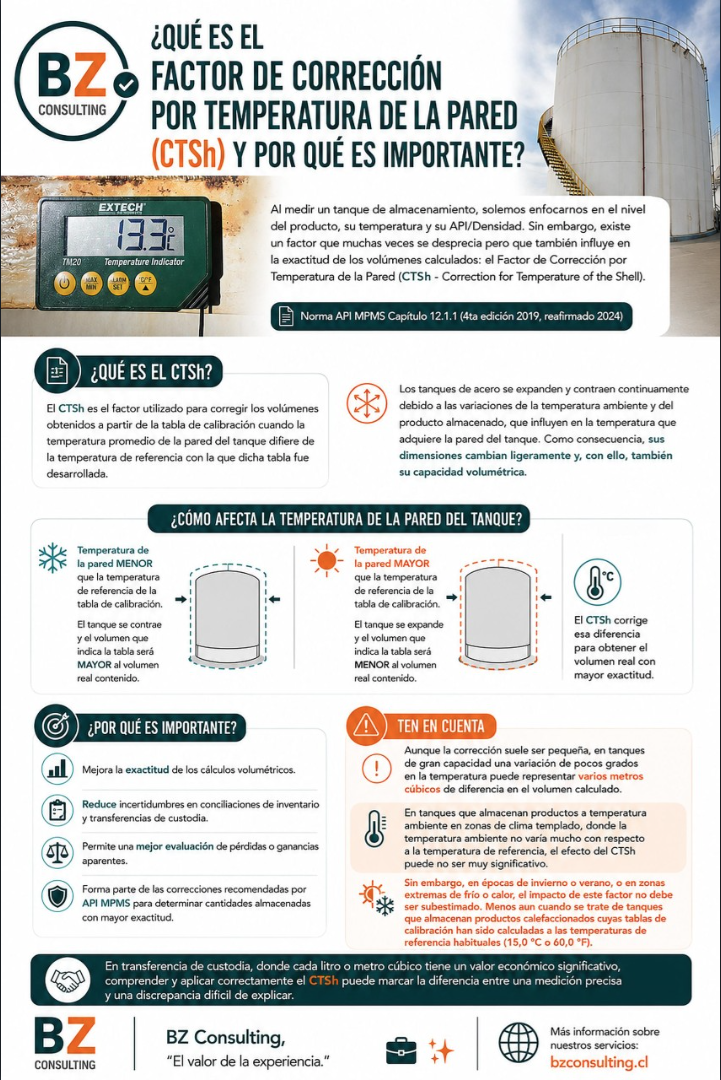
When discussing storage tank measurement, we tend to focus on the product level, its temperature, and its density. However, one factor is often overlooked even though it affects the accuracy of calculated volumes: the Tank Shell Temperature Correction Factor (CTSh - Correction for Temperature of the Shell), as defined in API MPMS 12.1.1.
When a tank is calibrated, the volumes in the Calibration Table are calculated for a specific Reference Temperature (usually 60.0 °F or 15.0 °C). This means that the tank’s capacity, at any liquid level, is calculated at that Reference Temperature.
However, steel tanks expand and contract due to variations in ambient temperature and the temperature of the stored product, both of which influence the temperature of the tank shell. As a result, the tank’s dimensions change slightly, and so does its volumetric capacity.
If the tank shell temperature is higher than the Calibration Table’s Reference Temperature, the tank expands and, therefore, the volume indicated by the table will be lower than the actual volume contained in the tank. Conversely, if the tank shell temperature is lower than the table’s Reference Temperature, the tank contracts and, consequently, the volume indicated by the table will be higher than the actual observed volume. The CTSh factor corrects this difference.
In summary, CTSh is the factor used to correct volumes obtained from the calibration table when the average tank shell temperature differs from the reference temperature at which the table was developed.
Although the correction is usually small, in large-capacity tanks a temperature variation of only a few degrees can represent a difference of several cubic meters in the calculated volume. In tanks storing products at ambient temperature in temperate climates, where the ambient temperature does not vary significantly from the calibration table’s reference temperature, the effect of the CTSh factor may not be very significant. However, during winter or summer, or in areas subject to extreme cold or heat, the impact of this factor should not be underestimated. This is even more important for tanks storing heated products whose calibration tables were calculated at the usual reference temperatures (15.0 °C or 60.0 °F).
In custody transfer, where every liter or cubic meter has significant economic value, understanding and correctly applying CTSh can make the difference between an accurate measurement and a discrepancy that is difficult to explain.